The Reference
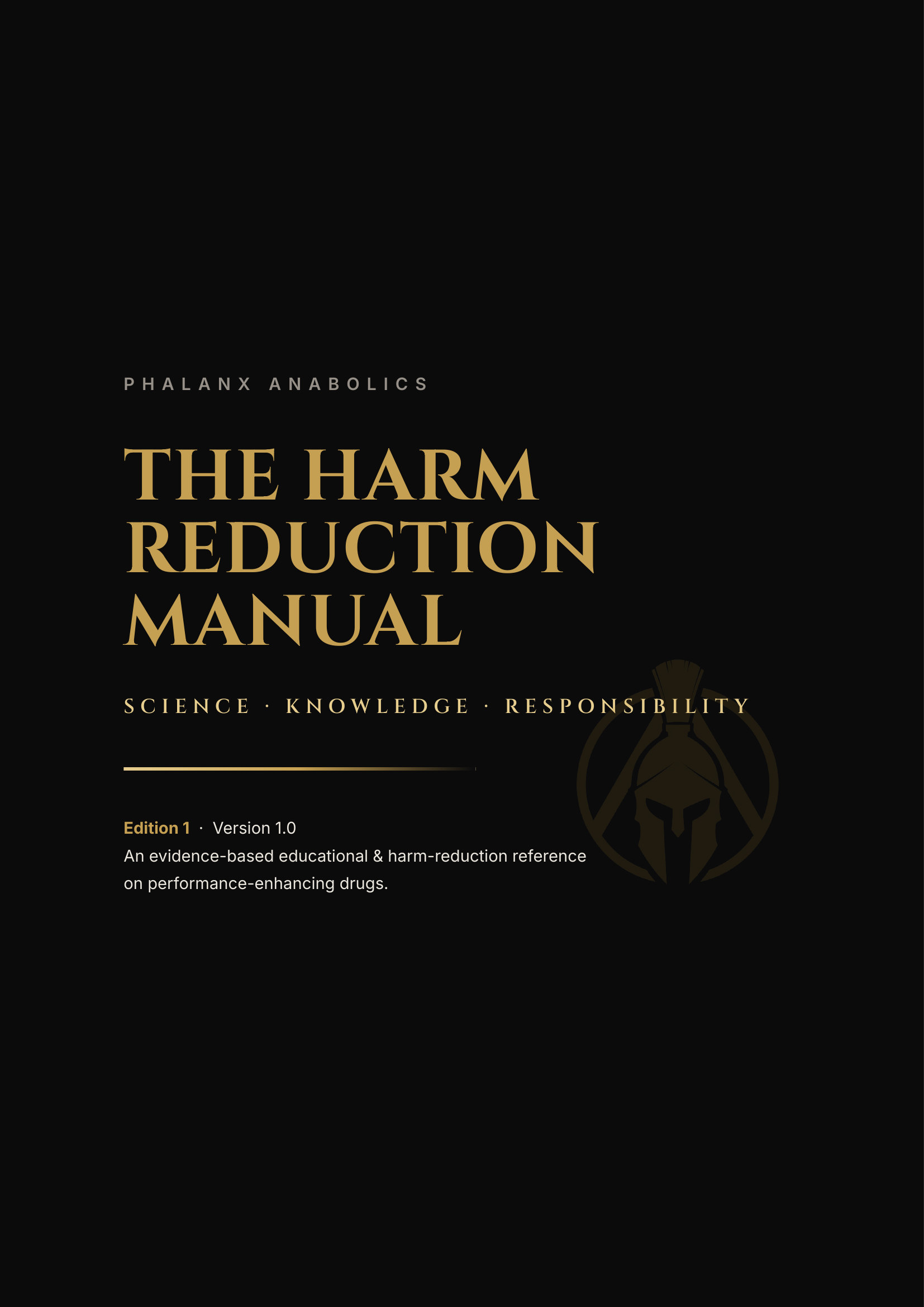
The Harm
Reduction Manual
Science · Knowledge · Responsibility
Six hundred and twenty-six pages of evidence-based education on performance-enhancing drugs — what they are, how they act on the body, the risks they carry, and how those risks can be recognised, monitored and lowered. A serious reference, built to a single standard.
Inside the Manual
Ten Parts, one standard
The manual is built as a complete reference. It moves from first principles and physiology, through a full bloodwork academy and detailed chapters on every major compound class, into health monitoring, injection medicine, medical emergencies, lifestyle and a comprehensive myth library.
Foundations
Why the manual exists, how to think clearly about evidence and risk, and the shared vocabulary the rest of the book relies on.
Human Physiology
The body systems that these substances act on — cells, hormones, the endocrine axes, muscle, liver, kidneys and the cardiovascular system.
Bloodwork Academy
A standalone bloodwork reference: how to read a panel, and marker-by-marker interpretation across haematology, lipids, hormones, metabolic, liver and renal.
Performance-Enhancing Drugs
Detailed, education-only chapters on every major compound class — what each is, how it acts, and the risks to recognise and monitor.
Health Monitoring
What to watch and why: cardiovascular monitoring, blood pressure and vascular health, bloodwork in practice, and the hormonal axis.
Injection Medicine
The injection itself, blood-borne viruses, abscesses and injection-site infections, and how injection harm can be reduced.
Medical Emergencies
Recognising an emergency and acting early — heat emergencies, hypoglycaemia and cardiac emergencies.
Lifestyle
The foundations that protect long-term health: mental health and body image, sleep and recovery, nutrition, and drug interactions.
The Myth Library
The most common and most consequential claims in this field, held up to the light — answering “is this true?”, not “how do I use it?”
Reference
A full glossary, medical abbreviations and a page-referenced index — so the whole work is quick to navigate and search.
From the Manual
Written to be read, and trusted
A reference is only as good as the standard it holds itself to. Every chapter opens with intent and closes with evidence — here is the tone the whole work is written in.
“Knowledge is the first line of defence.”
Part I · The Phalanx Principles“The heart is the highest-stakes organ here — and the one least likely to warn you in advance.”
Chapter 99 · Cardiovascular Monitoring“A myth and a fact can sound exactly the same. The difference is what stands behind the words.”
Part IX · The Myth LibraryEvery claim carries its confidence
Throughout the manual, statements are rated for how strong the evidence behind them is — so you are never asked to take a claim on faith. Where the evidence is thin, the manual says so plainly.
Preview First
Read a free sampler
Twenty-nine pages drawn directly from the full work, so you can judge the quality before you commit.
- The full front matter and complete table of contents
- An excerpt from the Performance-Enhancing Drugs section
- A complete chapter on cardiovascular monitoring
- The opening of the Myth Library
The Complete Reference
The Harm Reduction Manual
- 626 pages, ten Parts, 67 units — the complete work
- Fully bookmarked, searchable PDF for any device
- Every chapter referenced and confidence-rated
- Access granted as soon as your order is confirmed
The Harm Reduction Manual is an educational and harm-reduction reference. It explains physiology, mechanisms, risks, monitoring and emergency recognition, and it consistently encourages appropriate medical care. It does not contain dosing schedules, cycles, protocols or instructions for use, and it is not a substitute for professional medical advice.